 This is a cosmic close-up of the eastern Veil Nebula. The Veil Nebula itself is a large remnant of a previous star that went supernova. The Veil formed after the star exploded and sent its gaseous debris and the debris will continue to expand. While the Veil is within the constellation Cygnus, the swan, this portion of the eastern Veil spans only 1/2 degree, about the apparent size of the Moon. The Veil according to astronomers is 1,400 light years away from us on Earth. This photo was formed by converting the hydrogen atoms in the picture to the red hued spray and the oxygen to the blueish streaks. This nebula also contains the Witch's broom in its western portion.
Friday, November 1, 2013
APOD 2.1
This is a cosmic close-up of the eastern Veil Nebula. The Veil Nebula itself is a large remnant of a previous star that went supernova. The Veil formed after the star exploded and sent its gaseous debris and the debris will continue to expand. While the Veil is within the constellation Cygnus, the swan, this portion of the eastern Veil spans only 1/2 degree, about the apparent size of the Moon. The Veil according to astronomers is 1,400 light years away from us on Earth. This photo was formed by converting the hydrogen atoms in the picture to the red hued spray and the oxygen to the blueish streaks. This nebula also contains the Witch's broom in its western portion.

Friday, October 11, 2013
Georg Von Peuerbach Biography
Although not known by most, George von Peuerbach was a very influential character in astronomy, astrology, and mathematics. Much of Georg's early life is unknown other than that he was born on May 30, 1423. Peurerbach is the city in
which he lived , about 40 km west of Linz and so he should actually be known
as George of Peurerbach . Not much of his previous life is known, the first record of him is in his registration at the University of Vienna in 1446. The first recording is registered under the name Georgius Aunpekh Peurerbach . George studied in Vienna and earned a bachelor's degree in January, 1446. At university, he studied the art of standard courses, consisting mainly of humanities. He probably studied a little math , but the knowledge he had acquired in astronomy was self taught. He traveled through Europe 1448-1453 , although no trace remains exact dates . He had already acquired an international reputation as an astronomer although no publications at this time. He
taught in Germany, France and Italy, after talks on astronomy at
Bologna and Padua, he had a job opportunities at these universities offered
but declined . He
met the for the first time the Italian astronomer , Giovanni Bianchini , he tried to convince Peurerbach to accept the job at the Italian university. Peurerbach was back in Vienna in 1453, where he earned a Master's degree. During Peurerbach's lifetime there was a widespread belief that the heavenly bodies had influenced the lives and events of those on Earth . The
astrologer wanted to know the exact position of Sun, Moon and planets
at the time of birth of a person to create a graph that was to probably
predict the future of a person . Eclipses were of great importance and the appearance of a comet was treated as an important sign. He
was appointed astrologer of the court of King Ladislas V of Hungary and
Bohemia in 1454 Ladislas was only 14 years old when he appointed
Peurbach. Ladislas spent most of his time in Prague and Vienna so Peurerbach could also teach at the University of Vienna. Regiomontanus was a student at the University of Vienna, who was taught by Peurerbach . He graduated at the age of fifteen, and the following year of 1453 , he began working with Peurerbach . For eight years, until the death Peurerbach , astronomers have two excellent work together. In
Theo Ricae Planetarum Novae, which he completed in August of 1454 , Peurerbach
believed that the planets were in solid crystalline spheres , although
their movements were controlled by the raw sunlight and based these off of the theories of Ptolemy The book was given earlier in the lecture notes of a course by Peurbach at the University of Vienna in 1454. Peurerbach observed a lunar eclipse September 3, 1457 from a site near Vienna. He measured the length of the night , and found time to the center. It was eight minutes earlier than the scheduled time Alphonsine tables . These tables were manufactured in Toledo, Spain, King Alfonso X , was completed in 1252. Based on the theory of Ptolemy, they represent the best available time Peurerbach . Peurerbach
creates a new collection of tables of calculations Eclipse Tabulae
Ecclipsium which he finished around 1459 where he observed the eclipse on
July 3 and 27-28 December 1460 , he was able to compare the present
time with the predictions of its own table. He then met the minister Henry Barucher who fell on the special talent of George, and he promoted his education. The priest himself was a learned and respected priest and doctor of theology . In 1445 he sent his pupil to Vienna to university Peurerbach was already 22 years old. Even as a student he held lectures at the University itself . From
1448 , he spent three years in Italy with Nicolaus Cues
and taught at Padua , Bologna , Ferrara, and Rome. He became court astronomer to King Ladislaus of Bohemia. After his death in 1457 he entered the service of the Emperor Frederick III . Peurerbach and his pupil Regiomontanus reived access to the Greek
originals of Ptolemy and started the translation of the Almagest . The
Roman Cardinal Bessarion , a patron of the sciences and passionate
collector of Greek manuscripts , enabled them to this work. Peuerbach died of an unknown cause at age 37 , in the midst of a creative work phase , in April 1461 and this ended the work of an amazing astronomer and astrologist.
Friday, October 4, 2013
APOD 1.6
 This photo was taken on September 22nd, on the Equinox. This picture fills me with awe because in this photo we can capture our massive planet in one photo, and then compared to the rest of the universe, it is smaller than a pen dot. Even in this photo, we cannot even fully comprehend how small we as people are on this planet. This photo captures the whole hemisphere being lit by the sun, and this photo can be only captured on the two equinoxes.
Friday, September 27, 2013
Biography Sources
http://www.britannica.com/EBchecked/topic/454669/Georg-von-Peuerbach
http://www-history.mcs.st-andrews.ac.uk/Biographies/Peurbach.html.
http://www-history.mcs.st-andrews.ac.uk/Biographies/Peurbach.html.
APOD 1.4

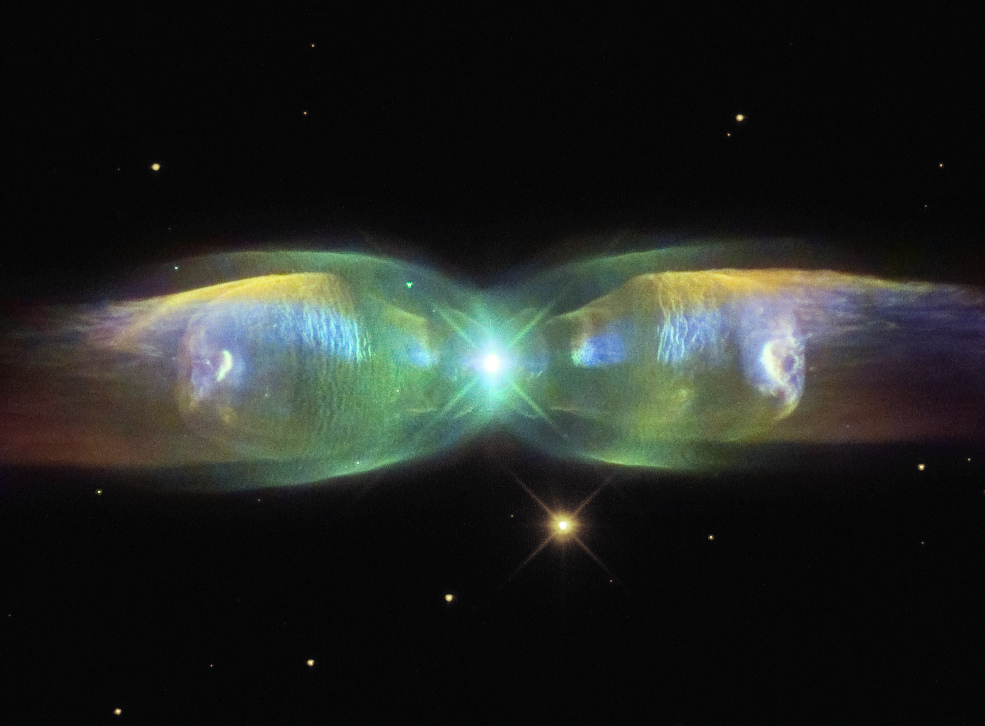
These are the wings of the butterfly nebula which is located a mere 2,100 light years from us. This wonderful creation is due to the gaseous expansion that occurs when a star turns into a white dwarf and is known as a planetary nebula. This picture is extremely beautiful due to its vibrant array of colors and symmetry
APOD 1.5
Friday, September 20, 2013
 |
Friday, September 13, 2013
APOD 1.3

Last Friday, off the coast off Virginia, Minotaur V, was launched into the Milky Way. This picture is inspiring to me because I have always since I had first learned about rockets and space exploration, seen it as one of the most exciting and interesting topics related to space. Without space exploration, we would not be able to know what we are seeing in the sky when we look up at night and unaware of the mysteries and environments surrounding us.
APOD 1.1

Over the volcano, Mount Lawu, during sunset, four bright stars were seen in an almost completely straight line. This line happens to be the ecliptic and on this line, the four planets Mercury, Venus, Mars, and Saturn aligned. This was truly amazing to me because seeing all four of the planets next to each other is so amazing and uncommon.
APOD 1.2
Subscribe to:
Posts (Atom)